I support free access to science. If you face a paywall for any of my publications, please contact me at ltrambaiolli@mclean.harvard.edu for a copy of the study (or click on the thumbnails to download it).
Names with * contributed equally to the study.
Highlighted publication
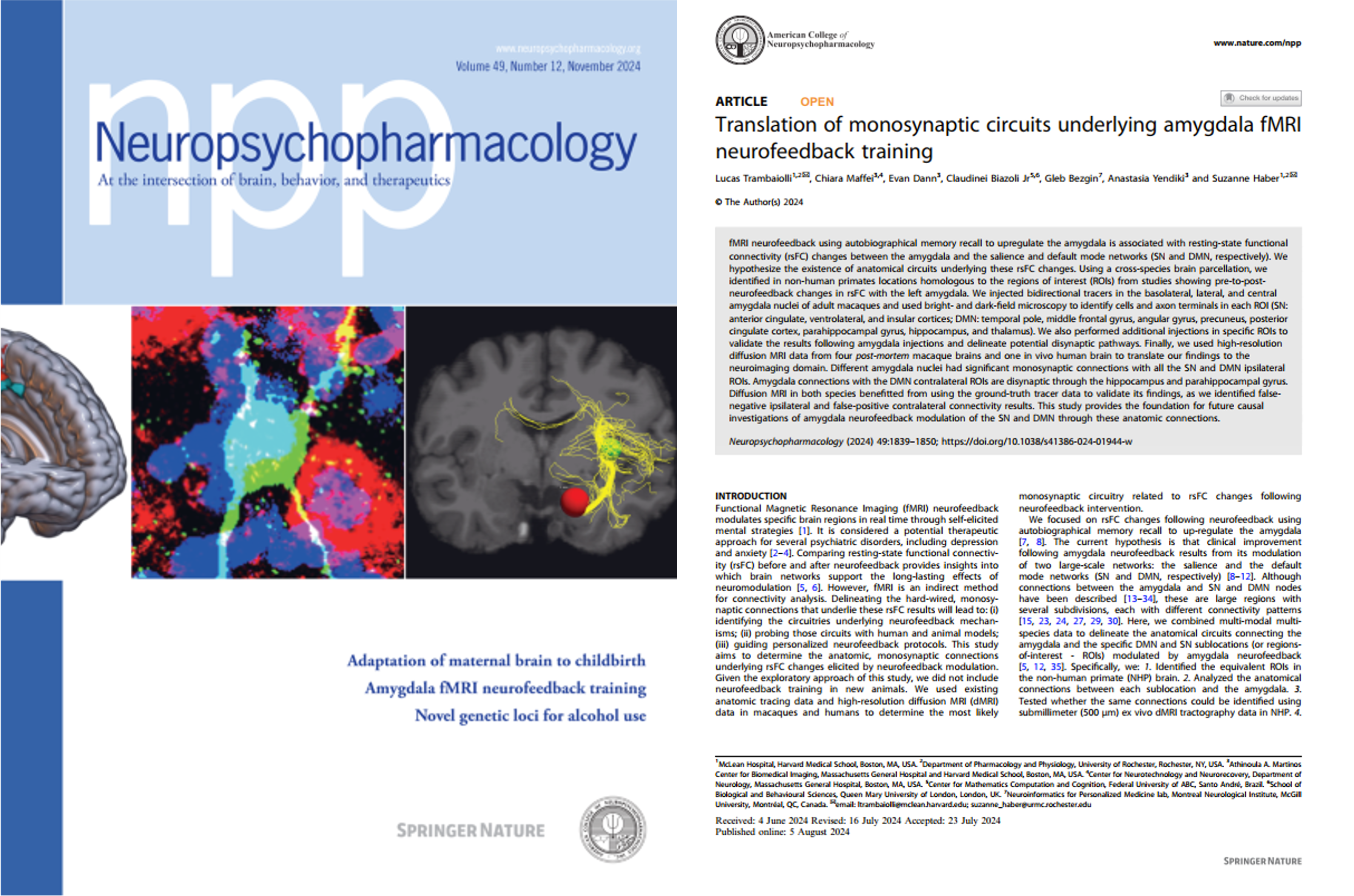
Translation of monosynaptic circuits underlying amygdala fMRI neurofeedback training
Trambaiolli LR, Maffei C, Biazoli CE, Bezgin G, Yendiki A, Haber SN. (2024). Neuropsychopharmacol. 49:1839–1850. DOI: https://doi.org/10.1038/s41386-024-01944-w
Abstract: fMRI neurofeedback using autobiographical memory recall to upregulate the amygdala is associated with resting-state functional connectivity (rsFC) changes between the amygdala and the salience and default mode networks (SN and DMN, respectively). We hypothesize the existence of anatomical circuits underlying these rsFC changes. Using a cross-species brain parcellation, we identified in non-human primates locations homologous to the regions of interest (ROIs) from studies showing pre-to-post-neurofeedback changes in rsFC with the left amygdala. We injected bidirectional tracers in the basolateral, lateral, and central amygdala nuclei of adult macaques and used bright- and dark-field microscopy to identify cells and axon terminals in each ROI (SN: anterior cingulate, ventrolateral, and insular cortices; DMN: temporal pole, middle frontal gyrus, angular gyrus, precuneus, posterior cingulate cortex, parahippocampal gyrus, hippocampus, and thalamus). We also performed additional injections in specific ROIs to validate the results following amygdala injections and delineate potential disynaptic pathways. Finally, we used high-resolution diffusion MRI data from four post-mortem macaque brains and one in vivo human brain to translate our findings to the neuroimaging domain. Different amygdala nuclei had significant monosynaptic connections with all the SN and DMN ipsilateral ROIs. Amygdala connections with the DMN contralateral ROIs are disynaptic through the hippocampus and parahippocampal gyrus. Diffusion MRI in both species benefitted from using the ground-truth tracer data to validate its findings, as we identified false-negative ipsilateral and false-positive contralateral connectivity results. This study provides the foundation for future causal investigations of amygdala neurofeedback modulation of the SN and DMN through these anatomic connections.
Full Articles in Peer-Reviewed Journals
Cross-species striatal hubs revealed by anatomical and functional connectivity.
Peng X*, Trambaiolli LR*, Linn G, Russ BE, Schroeder CE, Lehman JF, Haber SN, Liu H. (2024). Neuroimage. 301:120866. DOI: https://doi.org/10.1016/j.neuroimage.2024.120866

Translation of monosynaptic circuits underlying amygdala fMRI neurofeedback training.
Trambaiolli LR, Maffei C, Biazoli CE, Bezgin G, Yendiki A, Haber SN. (2024). Neuropsychopharmacol. 49:1839–1850. DOI: https://doi.org/10.1038/s41386-024-01944-w
Specific patterns of endogenous functional connectivity are associated with persistent harm avoidance in OCD.
Ghane M, Trambaiolli L, Bertocci M, Chase H, Brady T, Skeba A, Graur S, Bonar L, Iyengar S, Quirk G, Rasmussen S, Haber S, Phillips ML. (2024). Biol. Psychiatry. 96(2):137-146. DOI: 10.1016/j.biopsych.2023.12.027
Multimodal resting-state connectivity predicts affective neurofeedback performance.
Trambaiolli LR, Cassani R, Biazoli CE, Cravo AM, Sato JR, Falk TH. (2022). Front. Hum. Neurosci. 16:977776. DOI: 10.3389/fnhum.2022.977776
Anatomical and functional connectivity support the existence of a salience network node within the caudal ventrolateral prefrontal cortex.
Trambaiolli LR*, Peng X*, Lehman JF, Linn G, Russ BE, Schroeder CE, Liu H, Haber SN. (2022). eLife. 11:e76334. DOI: 10.7554/eLife.76334
Toward next-generation primate neuroscience: A collaboration-based strategic plan for integrative neuroimaging.
The PRIMatE Data and Resource Exchange (PRIME-DRE) Global Collaboration Workshop and Consortium (including Trambaiolli LR). (2022). Neuron., 110(1):16-20. DOI: 10.1016/j.neuron.2021.10.015
A prefrontal network integrates preferences for advance information about uncertain rewards and punishments.
Jezzini A, Bromberg-Martin ES*, Trambaiolli LR*, Haber SN, Monosov IE. (2021). Neuron., 109: 2339-2352.e5. DOI:
10.1016/j.neuron.2021.05.013

Neurofeedback and the aging brain: a systematic review of protocols for the treatment of dementia and cognitive impairment.
Trambaiolli LR, Cassani R, Mehler DMA, Falk TH. (2021). Front. Aging Neurosci., 13:682683. DOI: 10.3389/fnagi.2021.682683
Affective neurofeedback under naturalistic conditions: a mini-review of current achievements and open challenges.
Trambaiolli LR, Tiwari A, Falk TH. (2021). Front. Neuroergonomics., 2:678981. DOI: 10.3389/fnrgo.2021.678981
Closed-loop neurostimulation for affective symptoms and disorders: an overview.
Moreno JG, Biazoli Jr CE, Baptista AF, Trambaiolli LR. (2021). Biol. Psychol., 161:108081. DOI: 10.1016/j.biopsycho.2021.108081
Neurofeedback training in major depressive disorder: a systematic review of clinical efficacy, study quality and reporting practices.
Trambaiolli LR, Kohl SH, Linden DE, Mehler DMA. (2021). Neurosci. Biobehav. Rev., 125:33-56. DOI: 10.1016/j.neubiorev.2021.02.015

Subject-independent decoding of affective states using functional near-infrared spectroscopy.
Trambaiolli L, Tossato J, Cravo AM, Biazoli CE, Sato JR. (2021). Plos ONE., 16:e0244840. DOI: 10.1371/journal.pone.0244840
fNIRS-based affective neurofeedback: feedback effect, illiteracy phenomena, and whole-connectivity profiles.
Trambaiolli LR, Biazoli C, Cravo A, Falk TH, Sato J. (2018). Neurophotonics, 5:035009. DOI: 10.1117/1.NPh.5.3.035009

Predicting affective valence using cortical hemodynamic signals.
Trambaiolli L, Biazoli C, Cravo A, Sato J. (2018). Sci. Rep., 8:5406. DOI: 10.1038/s41598-018-23747-y
Feature selection before EEG classification supports the diagnosis of Alzheimer’s disease.
Trambaiolli LR, Spolaor N, Lorena AC, Anghinah R, Sato JR. (2017). Clin. Neurophysiol., 128:2058-2067. DOI: 10.1016/j.clinph.2017.06.251

The relevance of feature selection methods to the classification of obsessive-compulsive disorder based on volumetric measures.
Trambaiolli LR, Biazoli C, Balardin JB, Hoexter MQ, Sato JR. (2017). J. Affect. Disord., 222:49-56. DOI: 10.1016/j.jad.2017.06.061
Imaging Brain Function with Functional Near-Infrared Spectroscopy in Unconstrained Environments.
Balardin JB, Morais GAZ, Furucho RA, Trambaiolli LR, Vanzella P, Biazoli C, Sato JR. (2017). Front. Hum. Neurosci., 11:258. DOI: 10.3389/fnhum.2017.00258

Impact of communicative head movements on the quality of functional near-infrared spectroscopy signals: negligible effects for affirmative and negative gestures and consistent artifacts related to raising eyebrows.
Balardin JB, Morais GAZ, Furucho RA, Trambaiolli LR, Sato JR. (2017). J. Biomed. Opt., 22:046010. DOI: 10.1117/1.JBO.22.4.046010
Clinician’s road map to wavelet EEG as an Alzheimer’s disease biomarker.
Kanda PAM, Trambaiolli LR, Lorena AC, Fraga FJ, Basile LFI, Nitrini R, Anghinah R. (2013). Clin. EEG Neurosci., 45:104-112. DOI: 10.1177/1550059413486272

EEG Amplitude Modulation Analysis for Semi-Automated Diagnosis of Alzheimer’s Disease.
Falk TH, Fraga FJ, Trambaiolli L, Anghinah R. (2012). EURASIP J. Adv. Signal Process. (Online), 2012:192. DOI: 10.1186/1687-6180-2012-192
Does EEG montage influence Alzheimer’s Disease electroclinic diagnosis?
Trambaiolli LR, Lorena AC, Fraga FJ, Kanda PAM, Nitrini R, Anghinah R. (2011). Int. J. Alzheimers Dis., 2011:761891. DOI: 10.4061/2011/761891
Improving Alzheimer’s Disease Diagnosis with Machine Learning Techniques.
Trambaiolli LR, Lorena AC, Fraga FJ, Kanda PAM, Anghinah R, Nitrini R. (2011). Clin. EEG Neurosci., 42:60-165. DOI: 10.1177/155005941104200304
Full Articles in Peer-Reviewed Conferences
Feedback congruence affects real and perceived performance of an affective neurofeedback task.
Trambaiolli LR, Biazoli CE, Cravo AM, Sato JR. (2021). In: International IEEE EMBS Conference on Neural Engineering (NER’21), Virtual. DOI: 10.1109/NER49283.2021.9441389

Current brain activity is a predictor of longitudinal motor imagery performance.
Trambaiolli L, Dean P, Cravo A, Sterr A, Sato J. (2020). In: IEEE International Conference on Systems, Man, and Cybernetics (SMC’20), Toronto, Canada. DOI: 10.1109/SMC42975.2020.9283433
Resting-state global EEG connectivity predicts depression and anxiety severity.
Trambaiolli LR, Biazoli CE. (2020). In: International Conference of the IEEE Engineering in Medicine and Biology Society (EMBC’20), Montreal, Canada. DOI: 10.1109/EMBC44109.2020.9176161

EEG spectro-temporal amplitude modulation as a measurement of cortical hemodynamics: an EEG-fNIRS study.
Trambaiolli LR, Cassani R, Falk TH. (2020). In: International Conference of the IEEE Engineering in Medicine and Biology Society (EMBC’20), Montreal, Canada. DOI: 10.1109/EMBC44109.2020.9175409
On-task theta power is correlated to motor imagery performance.
Trambaiolli L, Dean P, Cravo A, Sterr A, Sato J. (2019). In: IEEE International Conference on Systems, Man, and Cybernetics (SMC’19), Bari, Italy. DOI: 10.1109/SMC.2019.8913980

Resting-awake EEG amplitude modulation can predict the performance of an fNIRS-based neurofeedback task.
Trambaiolli L, Cassani R, Biazoli Jr C, Cravo A, Sato J, Falk T. (2018). In: IEEE International Conference on Systems, Man, and Cybernetics (SMC’18), Miyazaki, Japan. DOI: 10.1109/SMC.2018.00199
Analysis of sample entropy during a resting-state EEG recording in Alzheimer’s disease.
Fernandes VG, Trambaiolli LR, Sato JR, Anghinah R, Fonseca A. (2015). In: 10th International Brazilian Meeting on Cognitive Science, 2015, Sao Paulo, Brazil.
Towards an EEG-based biomarker for Alzheimer’s disease: improving amplitude modulation analysis features.
Fraga FJ, Falk TH, Trambaiolli LR, Oliveira EF, Pinaya WHL, Kanda PAM, Anghinah R. (2013). In: IEEE International Conference on Acoustics, Speech and Signal Processing (ICASSP), Vancouver, Canada. DOI: 10.1109/ICASSP.2013.6637842
EEG Spectro-Temporal Modulation Energy: A New Feature for Automated Diagnosis of Alzheimer’s Disease.
Trambaiolli LR, Falk TH, Fraga FJ, Anghinah R, Lorena AC. (2011). In: International Conference of the IEEE Engineering in Medicine and Biology Society (EMBC’11), Boston, USA. doi: 10.1109/IEMBS.2011.6090951
Support Vector Machines in the Diagnosis of Alzheimer’s Disease.
Trambaiolli LR, Lorena AC, F.J. Fraga FJ, Anghinah R. (2010). In: ISSNIP Biosignals and Biorobotics Conference 2010, Vitoria, Brazil.
Book Chapters
Brain-computer interfaces for affective neurofeedback applications.
Trambaiolli LR, Falk TH. In: Fortino G., et al. (Ed) Handbook of Human-Machine Systems, 1ed.: IEEE Press. 23-33. DOI: 10.1002/9781119863663.ch3
Brain imaging methods in social and affective neuroscience: a machine learning perspective.
Trambaiolli LR, Biazoli CE, Sato JR. (2023). In: Boggio P., et al. (Org.). Social and Affective Neuroscience of Everyday Human Interaction, 1ed.: Springer, 213–230. DOI: 10.1007/978-3-031-08651-9_13
Hybrid Neurotechnology Systems.
Banville HJ*, Trambaiolli LR*, Falk TH. (2021). In: Swaine-Simon, S. et al. (Org.) The Neurotech Primer: a beginner’s guide to everything neurotechnology, 1ed.: NeuroTechX, 165-178.
Hybrid brain-computer interfaces for wheelchair control: a review of existing solutions, their advantages and open challenges.
Trambaiolli LR, Falk TH. (2018). In: Diez P (Org.). Smart Wheelchairs and brain-computer interfaces. 1ed.: Elsevier Inc, 229-256. DOI: 10.1016/B978-0-12-812892-3.00010-8
Comparison of EEG montages for diagnosis of Alzheimer’s disease using spectral features and Support Vector Machines.
Trambaiolli LR, Lorena AC, Fraga FJ, Anghinah R. (2012). In: Elizabeth TM (Org.). Neurocomputing: Learning, Architectures and Modeling. 1ed.: Nova Science Publishers, 83-92.
 Lucas R. Trambaiolli, Ph.D.